
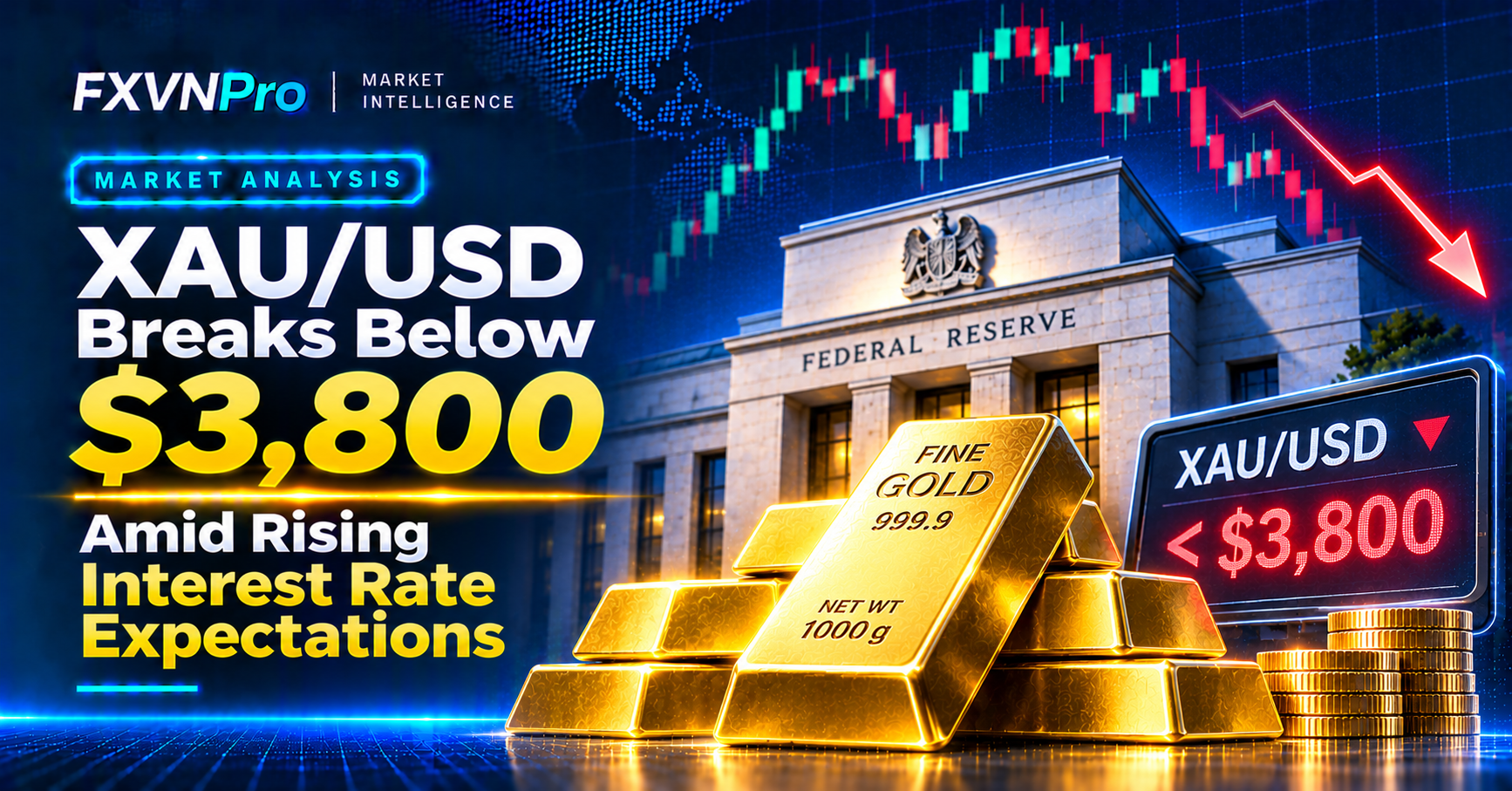
XAU/USD Breaks Below $3,800 Amid Rising Interest Rate Expectations
Gold (XAU/USD) fell below the $3,800 level for the first time since September 2025, pressured by expectations of further US interest rate hikes and a
Rebate Savings Calculator
Estimate cashback using verified USD/lot or percentage-of-spread rates, and compare trading costs.
Illustrative estimate only. Percentage-of-spread rebates apply to the spread component, not commission. Assumes every entered lot is eligible. Excludes swaps, slippage, conversion costs and other charges unless included in the verified cost figure. Negative net costs are possible mathematically and do not represent guaranteed profit. Actual rebate is subject to broker attribution, eligibility and reconciliation.
Open Rebate Wallet →Gold Declines Below Key $3,800 Level
According to a report published on November 18, 2026, gold (XAU/USD) extended its recent decline by breaking below the psychological $3,800 level for the first time since September 2025. This move marks a notable deterioration in gold’s price outlook after several months of consolidation. The precious metal’s sell-off has accelerated amid growing market expectations of further interest rate increases by the Federal Reserve (Fed), which have supported a stronger US Dollar and higher US Treasury yields.
The break below this major support zone comes ahead of the release of the Fed’s October monetary policy meeting minutes, which could offer additional insight into the central bank’s hawkish stance. The shift in gold’s price reflects a fundamental change in market expectations regarding US monetary policy, with investors increasingly anticipating a prolonged period of restrictive interest rates.
Interest Rate Expectations and Economic Data Influence Gold
Recent economic data have reinforced the view that the US economy remains resilient despite elevated borrowing costs. For example, US Retail Sales rose by 0.2% month-over-month in October, matching market expectations, following a 0.8% increase in September. This sustained consumer spending suggests that domestic demand continues to support inflationary pressures.
Market tools such as the CME FedWatch indicate that investors have fully priced in a 25-basis-point interest rate hike in December, with expectations for additional increases in January and March strengthening. Comments from Fed officials have underscored this outlook. St. Louis Fed President Alberto Musalem highlighted a “meaningful risk” that inflation could stay elevated, implying that several rate hikes may be necessary before spring. Meanwhile, New York Fed President John Williams noted inflation remains “stubbornly high,” though he suggested no need for “dramatic policy action” at present.
This increasingly restrictive monetary policy environment is generally unfavorable for gold, which does not yield interest and tends to lose appeal when yields on competing assets rise. Additionally, the US Dollar remains near its highest level since March 2025, supported by expectations of further Fed tightening, creating another headwind for gold buyers.
Trading Scenarios
- If the Fed minutes reinforce expectations of continued rate hikes and a hawkish stance, then gold prices may face further downward pressure below the $3,800 support level as US Treasury yields and the US Dollar strengthen.
- If economic data show signs of slowing inflation or weakening consumer demand, then market expectations for rate hikes could ease, potentially stabilizing or supporting gold prices above key support zones.
FXVNPro Market Perspective
Gold prices are sensitive to US monetary policy expectations because higher interest rates increase the opportunity cost of holding non-yielding assets like gold. When the Fed signals a prolonged period of restrictive rates, US Treasury yields tend to rise, making fixed-income assets more attractive relative to gold. Concurrently, a stronger US Dollar, often driven by expectations of Fed tightening, reduces gold’s appeal for holders of other currencies by increasing its local currency price.
Therefore, gold’s recent break below $3,800 reflects the market’s adjustment to a higher-for-longer interest rate environment. However, this relationship is conditional on ongoing economic data and Fed communications. Any shifts in inflation trends or Fed policy signals could alter the trajectory of gold prices.
What Traders Should Watch
- The release of the Fed’s October meeting minutes for indications of the central bank’s policy direction.
- Upcoming US inflation and retail sales data that could influence rate hike expectations.
- Movements in the US Dollar Index (DXY), particularly relative to its recent highs near March 2025 levels.
- US Treasury yields, as rising yields tend to weigh on gold prices.
Trade With A Regulated Broker





Related posts:
 Gold Price (XAU/USD) Edges Lower Amid Early US Midterm Trends Favoring Democrats
 Gold Price Outlook: Analyst Sees Potential Slide to $3,500 Ahead of US Jobs Data
 Australian Dollar Trades Near Monthly High Above 0.7000 Amid Hawkish RBA Signals and USD Dynamics
 Bitcoin Price Outlook: BTC Eyes Break Above Key Resistance Amid Institutional ETF Inflows
 SpaceX Earnings Highlight AI Supercycle Momentum and Compute Expansion
 Bitcoin’s Quantum Computing Threat Accelerates: Implications for Cryptocurrencies and Market Dynamics
 Cardano Price Forecast: Whale Selling Pressure Deepens ADA Correction
 WTI Rally Runs Ahead of Positioning: Insights from the October 2026 CFTC Report
 XAU/USD Outlook: Gold Gains as Fed Policy Week Begins Amid Inflation Concerns
 Central Banks Brace for Hawkish Moves Amid Energy-Driven Inflation, But Dovish Surprises Remain Possible
 BoJ Expected to Hold Rates Friday as Yen Retraces Half Its Recent Gains
 Ripple Secures OCC Approval for National Trust Bank, Impacting RLUSD Infrastructure
 MTrading $100 No Deposit Welcome Bonus (Malaysia Only): Terms, Limits & How It Really Works
 Altcoins XRP, Cardano, and Solana Face Continued Downside Pressure Amid Key Technical Tests
 Singapore Dollar Range-Bound Against US Dollar Amid Limited Momentum – UOB Analysis
 Bitcoin Faces AI-Linked Selloff Risk Amid Anthropic IPO and Inflation Concerns
 Zcash Price Forecast: Bullish Momentum Builds on ETF Inflows and Retail Interest
 Pi Network Price Outlook: PI Stalls Amid Core Team’s Investment Expansion to Axis Robotics
 Bitcoin Volatility Drops to 2023 Lows Amid Fed Rate Pause and Market Support Levels
 Crypto Market Pullback on Hawkish Fed Tone and Inflation Data – Bitcoin, Ethereum, XRP Under Pressure
 Gold (XAU/USD) Rebounds Near $3,900 Amid Inflation Concerns and Interest Rate Outlook
 Zcash Price Forecast: ZEC Rebounds Amid Support for Ending Community Grants and Upcoming Network Upgrade
 Dogecoin Price Outlook: Diverging Whale Activity and Technical Resistance Levels Signal Caution
 Understanding Inflation in November 2026: The Impact of Fuel Costs and Producer-Consumer Price Divergence
 Strategy Resumes Bitcoin Purchases with $65.5M Acquisition Amid Market Pressure
 Can the New Zealand Dollar Hold 0.5600 Amid RBNZ Policy Uncertainty?
 Canadian Dollar Decouples from Oil Amid US Political Shifts and Geopolitical Developments
 Australian Dollar Edges Lower Near 0.6865 Amid Robust US Jobs Data and RBA Rate Hike
 Australian Dollar Nears March Low Amid Divergent Monetary Policy Signals and US Dollar Strength
 US CPI Inflation Insights: What Headline Figures Miss About Price Trends
 USD/JPY Surpasses 159.00 Amid Fed Rate Hike Expectations and BoJ Policy Considerations
 USD/JPY Nears 160.00 Again Amid Renewed Intervention Concerns and Fed Rate Outlook
 Oil Prices Remain Elevated Amid High Costs and Geopolitical Risks – Rabobank Analysis
 EUR/GBP Price Forecast: Euro Dips Below 0.8350 Amid Risk-Off Mood and Geopolitical Tensions
 Euro Sinks Further Amid US Dollar Strength and Diverging Interest Rate Expectations
 Bank of Canada December Rate Hike Risk Remains Amid Inflation Pressures – RBC Analysis
 Bitcoin, Ethereum, Ripple Price Trends and Technical Outlook Amid Bearish Momentum
 CFTC Report Highlights Gold Buying Returns Amid Extreme Yen Exposure
 Euro Weakness Persists Ahead of ECB Rate Decision Amid US Tightening Expectations
 Silver (XAG/USD) Outlook: Analysts Diverge on Supply Deficit and Technical Recovery